
Boom Lake Trail, Banff: A Forest Walk to a Mountain Shore
A gradual forest approach to Boom Lake, with a substantial return distance and practical advice for a relaxed stop beside the water.


Boom Lake is a walk through the forest with a clear destination: a mountain lake where you can stop, eat lunch and look up at the slopes around you. The climb is gentler than many Banff hikes, but the return distance still calls for a substantial part of the day.
Choose it when you enjoy time beneath the trees and want a lake rather than a summit. The gradual ascent makes a good contrast to Banff’s steeper hikes, with around ten kilometres of walking overall.
At a glance
| Distance | About 10.2 km return on the Parks Canada route |
|---|---|
| Elevation gain | 180 m in the current park guide |
| Time | Allow 3–4 hours, plus an unhurried shore stop |
| Difficulty | Easy in the park guide; a longer walk with rough footing |
| Route | Out and back |
| Trailhead | Boom Lake Day-use Area, Highway 93 South |
| Facilities | Limited parking, accessible outhouses and picnic tables |
| Dogs | On leash, subject to current notices |
Parks Canada lists 5.1 km each way and 180 m of gain. The linked map records a slightly longer track, but both describe the same forest approach to the lake.
Trail map
Explore the route and recent trail reviews.
View this trail on AllTrailsThrough the forest
The signed trail starts at Boom Lake Day-use Area and climbs gradually into the forest.
The trees stay close for much of the approach, with the lake saved for the end rather than a succession of open viewpoints. This is a good walk for enjoying the woodland as well as the destination.
Underfoot, the route is less gentle than its overall gradient suggests. Rocks, roots, muddy patches and small streams break up the path; grippy waterproof footwear is useful after rain.
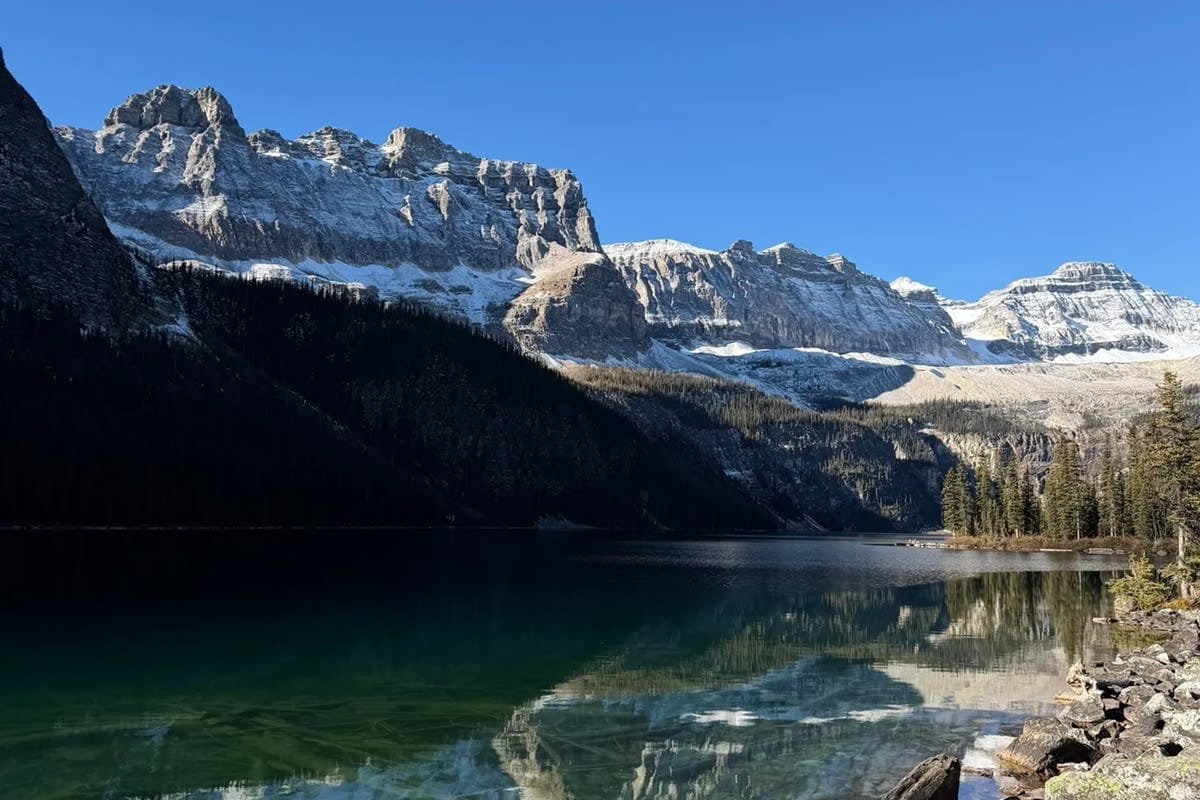
Arriving at Boom Lake
The change from enclosed forest to the lake is the walk’s main moment. Water and mountain walls replace the close view of trees, and you can finally see more of the landscape you’ve been walking into.
The rocky shore makes a good lunch stop with the mountain walls close above the water. It’s uneven ground, with little room in places, so keep children and dogs close to you.
On a calm day, the slopes reflect in the lake; a breeze can break the reflection in moments. A warm layer is useful while you sit beside the water after the sheltered approach.
The maintained walk ends at the lake, with the same forest trail leading back. There’s no shoreline circuit included in this route.
Directions, parking and facilities
From Banff or Canmore, drive west on the Trans-Canada to Castle Junction, then take Highway 93 South towards the continental divide and Kootenay. Look for the signed Boom Lake Day-use Area before continuing into the neighbouring park.
From Lake Louise, drive east to Castle Junction and turn onto Highway 93 South towards Boom Lake Day-use Area.
The small parking area can fill on busy days. Park only in designated spaces, not along the highway shoulder.
Outhouses and picnic tables are available at the day-use area. Bring drinking water and lunch for the lake.
National park admission applies.
Parks Canada’s hiking guide describes the route and facilities; the live trail report covers current conditions and warnings.
Choose the season for the outing you want
Summer and early autumn are the simplest planning choices for a walking visit. Snow can linger in shaded ground, and rain can leave mud even after the surrounding roads have dried.
Winter visits are a separate mountain activity. Parks Canada includes the Boom Lake area in its challenging avalanche-terrain ratings. The summer trail’s easy classification doesn’t describe the risks around a snow-covered lake or the slopes above it.
Frozen-lake travel and the avalanche slopes above the shore require a separate winter assessment and appropriate skills. For a straightforward snow-season stroll, choose a designated winter walking route.
What to bring and who it suits
Bring water, lunch, snacks, rain protection, warm clothing and a headtorch. Sun protection still matters at the lake, even after a shaded approach. Keep a downloaded map available for orientation.
Carry accessible bear spray and know how to use it, keep dogs on leash and pack out food scraps and other waste.
Boom Lake is a good family choice for children who enjoy longer walks. The main demand is the return distance rather than a big climb.
The boulders, roots, streams and mud make this unsuitable for conventional strollers or wheelchairs.
For a different kind of outing back in Banff, Cave and Basin combines hot-springs history with shorter walks.
Boom Lake’s appeal is in the contrast: a long, enclosed forest approach followed by open water and mountain walls. Leave time for the shore; that’s where the walk changes character.
FAQs:
How long is the Boom Lake hike?
Parks Canada lists 5.1 km each way, or about 10.2 km return. Allow 3–4 hours and extra time for lunch beside the lake.
Is Boom Lake an easy walk?
The park classifies it as easy, but the distance and rough ground still need preparation. Expect roots, stones, wet patches and small streams.
Does the route circle the lake?
No. This guide follows the approach to the lake and returns the same way. It doesn’t include a shoreline circuit or mountain traverse.
Can I use the same plan in winter?
No. The Boom Lake area includes challenging avalanche terrain. A winter trip needs separate advice, skills and conditions checks; the summer rating doesn’t establish winter safety.


