
Wait - Are Those Lizards on the Bow Valley Parkway?
Pilot Pond was known as Lizard Lake, and then it was stocked with trout for forty-eight years. Trout eat salamander larvae. The population is coming back slowly, and every mid-April the survivors cross the Bow Valley Parkway at night, which is why the speed limit drops to 20 km/h.

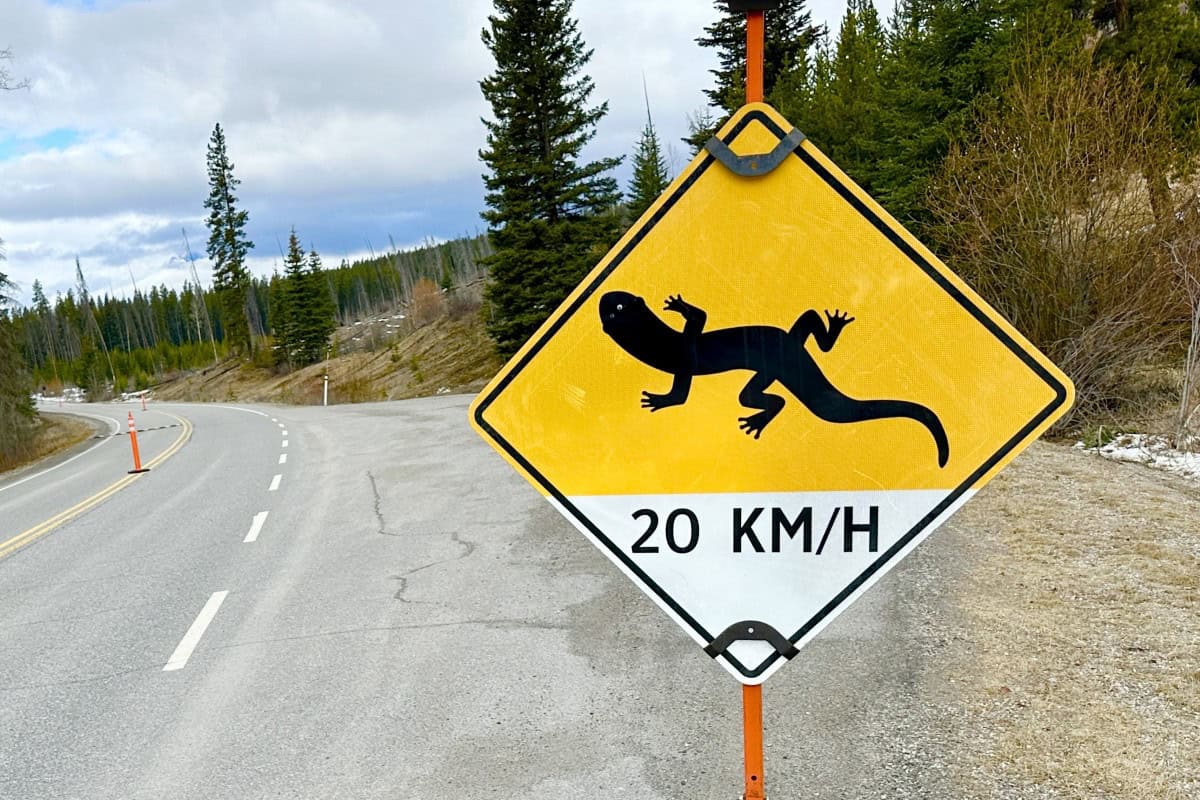
If you've driven the Bow Valley Parkway in mid-April and noticed a small yellow-and-black sign warning you to slow down for salamanders, you were probably doing a quick mental double-take. Salamanders? In Banff?
The long-toed salamander is one of only two salamander species in Alberta, and every spring it stages a quiet migration across one of the park's most scenic roads. Here is what is actually happening - and why Parks Canada cares about it more than you might expect.
Not a Lizard. Not Quite What You'd Expect.
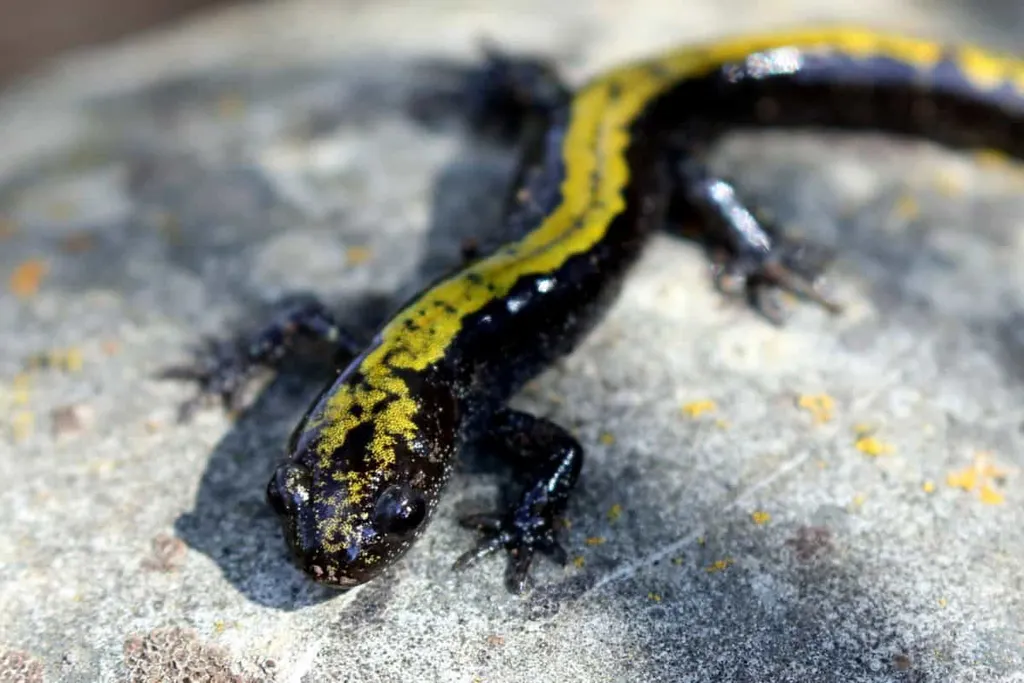
The long-toed salamander is a small amphibian, typically somewhere between 8 and 14 centimetres long. It is dark grey to black, with a narrow, irregular yellow stripe running down its back and a scattering of white flecks along its sides.
The name comes from the noticeably elongated fourth toe on each hind foot - a detail you would only appreciate at very close range, which is not a situation you will often find yourself in.
It spends most of its life underground or buried in forest debris, entirely nocturnal, entirely invisible. You could walk the Bow Valley Parkway a hundred times and never see one. They do not call or chirp like frogs. They do not draw attention to themselves in any way. For about three weeks each spring, that changes.
The Pilot Pond Story
About 24 kilometres west of the Banff townsite, just off the Bow Valley Parkway, sits a small kettle pond called Pilot Pond. Locals used to call it Lizard Lake - not because of lizards, but because of the sheer number of long-toed salamanders that gathered there each spring to breed. The name was informal and widely used, and then the pond was officially renamed. The salamanders stayed.
Between 1926 and 1974, the pond was stocked with non-native rainbow and brook trout for recreational fishing. Trout eat salamander larvae. By the time the stocking stopped, the population had been nearly wiped out.
It is a straightforward cautionary tale about what happens when you introduce a predator into an ecosystem without thinking it through - and the fact that it happened inside a national park does not make it any less instructive.
Since stocking ended, the salamanders have been making a slow recovery. Parks Canada researchers now survey 60 breeding sites across the eastern section of the park twice each year, in mid-April and again at the end of May. Pilot Pond is one of those sites. The population is coming back, but it is not a fast process.
The Spring Migration
In mid-April, adult salamanders emerge from the forest floor and make their way to Pilot Pond and other breeding sites to lay eggs. The migration happens at night, often coinciding with the first warm, wet evenings of spring. The animals are dark, slow-moving, and small enough to disappear into a wheel rut.
The 20 km/h speed limit on the Parkway during this period is not symbolic. At normal road speeds, you would not see one in time. The sign exists because Parks Canada actually needs drivers to act on it.
The breeding season at this elevation typically runs from mid-April into May, often beginning before the ice has fully receded from the shallower ponds. Males arrive first and stay longer.
Females lay eggs singly or in small clusters attached to submerged sticks and vegetation in the shallower sections of the pond. The larvae hatch two to five weeks later and spend the summer in the water before moving onto land by late summer.
Once breeding is done, the adults head back into the forest and disappear again until the following spring. Their return migration is spread out over a much longer period - nothing like the focused crossing of April.
The Bow Valley Parkway Travel Restriction
The salamander crossing sits within a broader seasonal wildlife restriction on the Bow Valley Parkway that is worth knowing about before you plan your visit.
From March 1 to June 25 each year, no travel is permitted on the eastern 17-kilometre section of the Parkway - between the Fireside Picnic Area and Johnston Canyon - between 8 p.m. and 8 a.m. This applies to vehicles, cyclists, and walkers.
The restriction is in place to give wildlife the run of the montane corridor during the hours when they use it most. Grizzly bears, wolves, and elk all rely on this section of the valley in spring, when it is one of the first areas in the park to green up, and the rest of the mountains are still locked under snow.
The fine for violating the closure is up to $25,000. Parks Canada enforces it.
In addition to the overnight restriction, the same eastern section is closed to public vehicles from 8 a.m. to 8 p.m. between May 1 and June 25 as part of the Bow Valley Parkway Cycling Pilot, which runs until 2030. During those hours, the road belongs to cyclists and walkers. Drivers heading to Johnston Canyon can access it from Castle Junction off the Trans-Canada Highway instead.
Practical Information
Getting There
Pilot Pond is located approximately 24 kilometres west of Banff townsite along the Bow Valley Parkway (Highway 1A). There is a pull-off and interpretive sign on the south side of the road. Access the Parkway from the Fireside interchange off the Trans-Canada Highway, east of the townsite.
Travel Restriction Hours
The eastern 17-kilometre section (Fireside Picnic Area to Johnston Canyon) is closed to all travel between 8 p.m. and 8 a.m. from March 1 to June 25. Vehicles are also restricted during daytime hours (8 a.m. to 8 p.m.) from May 1 to June 25 under the cycling pilot. Plan your drive accordingly.
Best Timing to See Salamanders
Mid-April to early May, in the evening or at night. They are nocturnal, so any sighting during daylight hours is opportunistic. If you are on the Parkway by bike or on foot during this period, slow down near Pilot Pond and scan the road surface carefully.
Cost
No additional charge beyond your Parks Canada park pass, which is required to enter Banff National Park.
Accessibility
The pull-off and interpretive sign at Pilot Pond are accessible by vehicle or bicycle. The pond itself is not developed for visitor access.
FAQs: Long-Toed Salamander Banff
Are there really salamanders in Banff National Park?
Yes - the long-toed salamander is one of only two salamander species found in Alberta, and it lives throughout the western mountain parks, including Banff. It is rarely seen because it spends most of its life underground and is strictly nocturnal. Spring migration to breeding ponds is the one time you have a realistic chance of spotting one.
When do long-toed salamanders cross the Bow Valley Parkway?
The main migration window at Banff's elevation is mid-April to early May. Adults emerge from the forest on warm, wet nights and move toward breeding ponds like Pilot Pond. The return migration happens after breeding but is spread out over a much longer period and is far less concentrated.
What does the long-toed salamander look like?
It is a small amphibian, typically 8 to 14 centimetres long, with a dark grey to black body and a narrow yellow stripe running down its back. White flecking appears along the sides. The long fourth toe on the hind foot gives it the name. It does not call or make noise of any kind.
What is the travel restriction on the Bow Valley Parkway in the spring?
From March 1 to June 25, no travel - vehicles, bikes, or foot traffic - is permitted on the eastern 17-kilometre section of the Parkway (Fireside Picnic Area to Johnston Canyon) between 8 p.m. and 8 a.m. From May 1 to June 25, vehicles are also excluded during daytime hours as part of the Bow Valley Parkway Cycling Pilot. The fine for violations can reach $25,000.
Why was Pilot Pond nearly emptied of long-toed salamanders in Banff?
Between 1926 and 1974, the pond was stocked with non-native rainbow and brook trout for recreational fishing. Trout eat salamander larvae, and the population was nearly eliminated as a result. Since stocking stopped, the salamanders have been recovering slowly. Parks Canada now monitors the site twice yearly as part of its amphibian health program.


