
Calgary Zoo Grizzly Bears Fitz and Turner: A Story of Loss and New Beginnings
The Calgary Zoo lost Skoki in September, then Khutzey three weeks later, both at 35. Ninety years of grizzly care, and for a moment none. Then a call came from Diamond Valley about two orphaned cubs who needed exactly what that team had spent ninety years learning to give.

In early September 2025, the Calgary Zoo said goodbye to Skoki.
He was 35 years old - an exceptional age for a grizzly bear - and he'd spent most of his life at the zoo after being rescued from Banff National Park.
A wild-born bear who never made it back to the wild, but who, by most accounts, had a good life.
A cared-for life. A life that mattered to the people who showed up every year just to stand at the edge of his habitat and watch him do bear things.
Three weeks later, they said goodbye to Skoki's companion, Khutzeymateen. Khutzey. Also 35.
Born at the zoo, she'd never known anything but the sound of those familiar voices and the smell of those familiar hands.
She was walked home with a planned euthanasia on September 30, after her health declined.
They used the phrase "lovingly walked home." And if that doesn't catch in your throat a little, I don't know what to tell you.
Ninety years of grizzly care at the Calgary Zoo - and for a moment, it was just over.
Fitz And Turner Meet The Public
The grief that comes with the job
The thing about working in wildlife care is that you know this is coming.
You know the bears you raise from cubs will age, and you'll love them anyway, and the grief at the end will be proportional to exactly how much you let yourself care.
The Calgary Zoo team let themselves care a lot.
You can tell from the way they talk about Skoki and Khutzey, from the words they chose. Their hearts were heavy.
That's not press release language. That's someone trying to say something true in a situation where words feel inadequate.
And then, about two weeks after Khutzey died, a call came in from southern Alberta.
Two cubs who needed somewhere to go
It's their Birthday
A mother grizzly had been killed in a human-wildlife encounter near Diamond Valley.
Her cubs - two of them, born that same year, far too young to survive on their own - had been found.
Alberta Fish & Wildlife moved quickly. The zoo, still raw from loss, said yes.
"These cubs needed our help," said Kim Walker, Senior Manager of Animal Care, Health & Welfare. "But in many ways, we needed them too."
That sentence is doing a lot of work. Read it again.
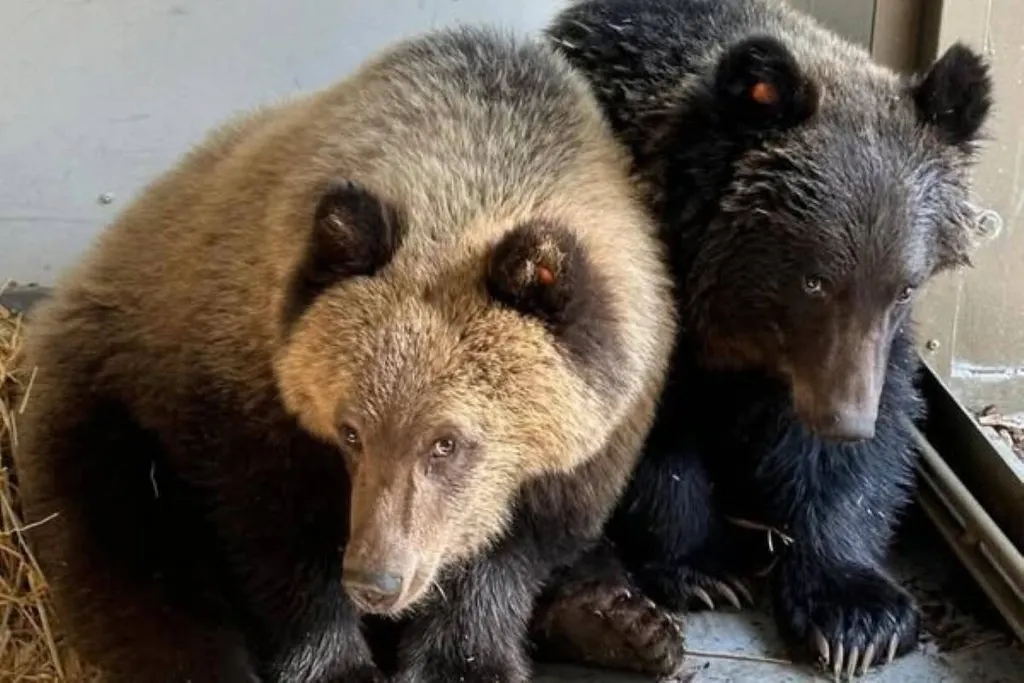
The cubs arrived in mid-September, just days after Skoki was gone - a slightly darker one and a lighter one.
Two small animals who had no idea what had happened to their mother, no understanding of where they were or why, no reason yet to trust the strange humans standing nearby.
Those humans kept their distance, made themselves small, and waited.
Because that's how you build trust with a grizzly bear cub. Slowly. Patiently. On the bear's terms.
Meet Fitz and Turner
They have names!
It took a few months before they had names.
A health exam confirmed something the team hadn't been certain of - both cubs, originally thought to be a male and a female, were in fact brothers.
So they named them for the place they came from.
Fitz - the lighter one, the bolder one, the one who explores new spaces first and stays out of the den longer than his brother - is named after Fitzsimmons Creek, near Diamond Valley.
Turner - the darker one, more reserved, quietly brilliant, the one who figures out a puzzle feeder and carries it back to the den - is named after Turner Valley.
Brothers. Named for southern Alberta. Named so they'd carry some piece of where they came from, even if they'll never go back.
The part that sits heaviest
They can't go back.
Unlike black bears, orphaned grizzly cubs can't be rehabilitated and released. Even well-intentioned human contact alters them - makes them lose the fear of people that keeps them, and us, safe.
The zoo isn't a waystation. It's a permanent home.
The life Fitz and Turner will have is the life they'll always have.
But here's what that life looks like: dedicated caregivers who know them by name and by personality.
Training sessions built entirely around trust and positive reinforcement - always voluntary, always on the cubs' terms.
Enrichment. Snacks. A brother to sleep next to in the den.
A habitat where thousands of people can stand at the edge and watch them do bear things - the same thing people did with Skoki for decades, the same thing they did with Khutzey.
A symmetry that doesn't resolve neatly - and shouldn't
Two old bears died. Two cubs were orphaned.
A zoo that had cared for grizzlies for nearly 90 years found itself, briefly, with none.
And then, in the way that life sometimes insists on continuing, two small bears arrived who needed exactly what that team had spent 90 years learning to give.
Fitz and Turner are expected to make their public debut in Wild Canada at the Calgary Zoo sometime this spring.
If you go - and I'd suggest you go - you'll see two young grizzlies doing what young grizzlies do.
Fitz will probably be out exploring first. Turner might be doing something clever with an enrichment device you wouldn't have thought to give him.
And somewhere in the background, there will be people who spent the hardest autumn of their careers quietly rebuilding something they thought was over.
That's the story. It's sad in the middle and hopeful at the end, and it doesn't tie up cleanly because nothing real ever does.
But Skoki and Khutzey had long, cared-for lives.
And Fitz and Turner, against all the odds that stacked against them the day their mother didn't come home, have a future.
Sometimes that's enough. Sometimes that's everything.
Fitz and Turner will be making their public debut in Wild Canada at the Wilder Institute/Calgary Zoo in Calgary, Alberta - keep an eye on the zoo's social media for news on when they go on exhibit.
Image: Wilder Institute, Calgary Zoo


