
Banff Merman: A Visitor’s Guide To Banff’s Most Unusual Display
A taxidermy gaff in a glass case at the Banff Trading Post, in the screaming Ningyo tradition, with a backstory that doesn't hold up: the shop said Norman Luxton bought it in Java, but Luxton never got past Fiji. Where to find it, what it's made of, and why it's still there.

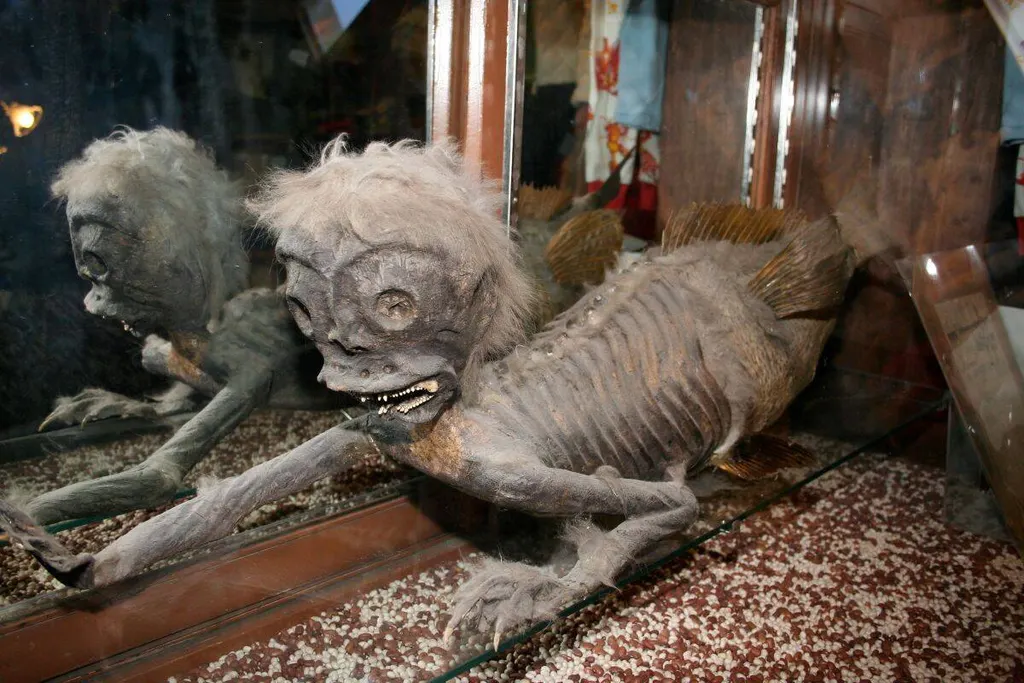
If you have spent any time exploring Banff, you have probably admired the mountains, the river, and the wildlife. But you may not be expecting the creature that greets you at the Banff Trading Post. Inside a glass case sits the Banff Merman, a taxidermy creation with a startled expression and a dramatic pose that never fails to make people pause. It is one of the town’s longest-running curiosities, and its backstory is even stranger than its appearance.
What the Merman Actually Is
The Banff Merman is a classic taxidermy gaff. It belongs to a long tradition of crafted mer-creatures known as Feejee Mermaids. These originated in Japan’s Ningyo folklore, where artisans combined parts of fish, primates, wood, wire, and papier-mache to create fish-human hybrids meant for shrines or travelling shows. The Banff version fits the “screaming” style, complete with raised hands, prominent ribs, and a look that suggests someone just told it how cold Lake Minnewanka is in winter.
People sometimes mistake it for a Jenny Haniver, but those are made from dried rays and are far simpler. The Merman is more complex, more labour-intensive, and definitely more dramatic.
How It Landed in Banff
For that part of the story, we turn to Norman K. Luxton. Known locally as Mr. Banff, he was a shopkeeper, newspaper owner, museum founder, and adventurer. In 1901, he joined the Pacific voyage of the Tilikum. It was an ambitious journey in a modified dugout canoe, but he only made it to Fiji before illness forced him home.
For decades, the Trading Post claimed that Luxton bought the Merman in Java. The problem with that version is that Luxton never sailed to Java. Historians now believe he purchased the creature from a curio wholesaler, just as many shopkeepers did during the era when exotic oddities were reliable crowd-pleasers.
A Marketing Tool With Personality
When Luxton returned to Canada, he opened the Sign of the Goat Curio Shop, which later evolved into the Banff Trading Post. He knew that visitors loved surprises, so the Merman became a centrepiece attraction. It was never meant to fool anyone into scientific belief. It was meant to spark curiosity and conversation, and it has succeeded for more than a century.
The shop also connected the Merman to local lore. Lake Minnewanka has long-standing Stoney Nakoda stories about water spirits, and the Trading Post cleverly used these legends to suggest a local connection. They even referenced an 1812 deposition from voyageur Venant St. Germain, who swore he saw a merman-like creature near Isle Paté on Lake Superior. It has nothing to do with Banff geographically, but it certainly adds atmosphere.
Planning Your Visit
The Banff Merman lives at the Banff Trading Post at 101 Cave Avenue. It is right at the end of the Bow River Bridge, next to the Buffalo Nations Luxton Museum. You can walk there from downtown in under ten minutes. Viewing the Merman is free, although most people end up buying something small out of sheer amusement.
The best time to visit is mid-morning. Summer gets busy with bus tours, and midday light can create reflections on the glass case. A polarizing filter helps if you are trying for a glare-free photo. In winter, the shop is quieter, and you may get the Merman all to yourself.
Parking options include the train station lot, Bow Avenue, and the Bear Street Parkade. The shop’s small parking area fills quickly, especially on summer weekends.
The Craft Behind the Creature
For something its size, the Merman has a surprising amount of detail. The head resembles a desiccated primate skull, with a domed shape and hollow eyes. The torso suggests ribs, although many gaffs of this type use wire under papier-mache rather than actual bone. The fish tail is often made from real skin stretched over a wooden frame. The craftsmanship matters, because these figures were meant to survive travel and display.
The pose itself is striking. With hands lifted toward its face, it looks distressed, alarmed, or simply displeased with the lighting. This posture is typical of the “screaming Ningyo” category and is part of what makes the Banff Merman so memorable.
Why It Still Matters
Beyond its value as a conversation starter, the Banff Merman offers a glimpse into early tourism in the Rockies. It reflects a time when visitors wanted both authentic Indigenous art and theatrical oddities. It also highlights Luxton’s influence in shaping Banff’s identity, from newspapers to museums to one very expressive hybrid creature sitting quietly in a corner.
There are similar mer-creatures in museums from Seattle to London, but Banff’s version has become part of local heritage. It has even inspired tributes like the Curbside Museum exhibit, proving that a well-crafted oddity can outlast trends, fads, and a century of visitors tapping on the glass (even though they should not).
If you want a quick, quirky stop between hikes and viewpoints, the Merman is an easy addition to your Banff itinerary. Just be prepared for it to look startled. It has been doing that for over a hundred years.
FAQs About the Banff Merman
Where can I see the Banff Merman?
At the Banff Trading Post, located at 101 Cave Avenue, just across the Bow River Bridge.
Is the Banff Merman a real creature?
No. It is a handcrafted taxidermy gaff built from mixed materials in the style of the Japanese Ningyo tradition.
Did Norman Luxton bring the Merman from Java?
No. Luxton never reached Java during the Tilikum voyage. The Merman was likely bought from a curio wholesaler.
Why does the Merman look like it is screaming?
Its posture follows a style known as the screaming Ningyo type, designed to create a dramatic and eye-catching expression.
Can I take photos of the Merman?
Yes. Personal photography is allowed, and a polarising filter helps reduce glare on the display case.
Featured Image: “The Banff Merman” by Banff Lake Louise, CC BY-NC-ND 2.0


